JShell Startup Configuration
The Java jshell tool is useful for rapid prototyping of simple Java code, or for testing some functionality. An introduction can be found here.
Ubuntu Setup
On Ubuntu, I configured the Terminal application to have a special JShell terminal, like shown in the screenshot below. It is from the Ubuntu terminal application, and – as you may have noticed already – in German:
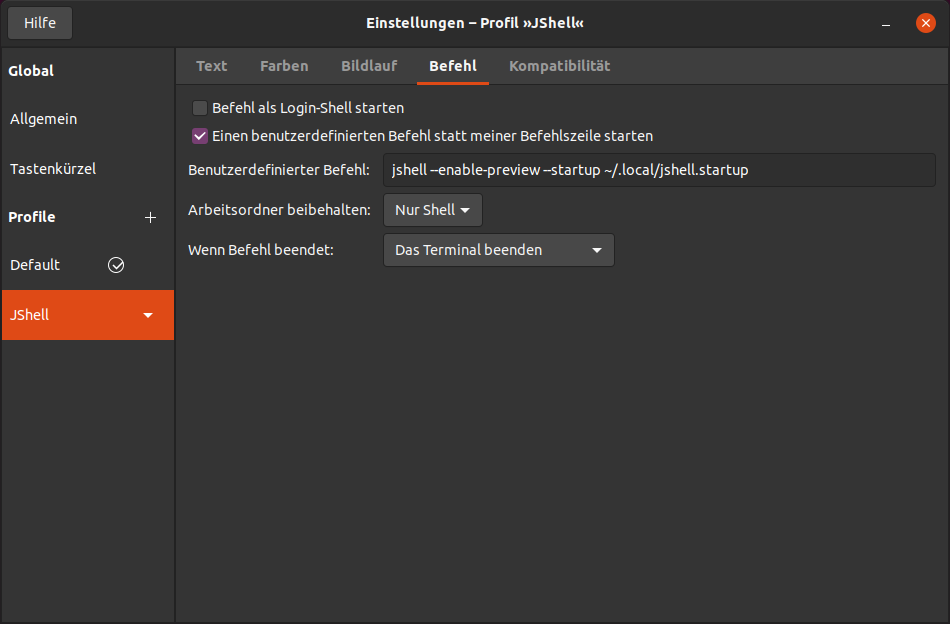
JShell starts there with this command:
jshell --enable-preview --enable-preview --startup DEFAULT --startup PRINTING --startup TOOLING --startup ~/.local/jshell.startup
Raspberry Pi OS Setup
On the Raspberry, the setup is a little bit different; there I creates a shell script in the ~/bin folder, usually named jshell (to work as expected requires that the $PATH variable mentions ~/bin before /usr/bin).
That script looks like this:
#!/bin/bash
PRG="/usr/bin/jshell"
SCRIPT_DIR="$(cd "$(dirname "${BASH_SOURCE[0]}")" && pwd)"
STARTUP="$SCRIPT_DIR/jshell.startup"
$PRG --enable-preview --enable-preview --startup DEFAULT --startup PRINTING --startup TOOLING --startup $STARTUP $*
It expects that the file jshell.startup is stored in ~/bin, too.
The jshell.startup File
For Ubuntu, the file should be stored in ~/.local (in particular when the setup described above is used), while on Raspberry Pi OS I recommend to store it with the described startup shell script in ~/bin.
The file jshell.startup then looks like this; it provides some additional commands, too:
import module java.base; // Usually loaded already through DEFAULT

import static java.lang.IO.*;
import static java.lang.Math.*;
import static java.lang.System.*;
import static java.nio.file.Files.*;
import static java.time.temporal.ChronoUnit.*;
import static java.util.Objects.*;
import static java.util.regex.Pattern.*;

void listEnv() {
  final var properties = getenv().keySet()
    .stream()
    .map( Object::toString )
    .sorted()
    .toArray( String []::new );
  var maxLen = -1;
  for( final var property : properties ) maxLen = max( maxLen, property.length() );
  ++maxLen;
  final var halfCount = properties.length / 2;
  final var offset = halfCount + properties.length % 2;
  final var lineTemplate = " - %1$s%3$s - %2$s%n";
  for( var i = 0; i < halfCount; ++i )
  {
    printf( lineTemplate, properties [i], properties [i + offset], " ".repeat( maxLen - properties [i].length() ) );
  }
  if( offset != halfCount ) printf( " - %s%n", properties [halfCount] );
}

void listProperties() {
  final var properties = getProperties().keySet()
    .stream()
    .map( Object::toString )
    .sorted()
    .toArray( String []::new );
  final var halfCount = properties.length / 2;
  final var offset = halfCount + properties.length % 2;
  final var lineTemplate = " - %1$s%3$s - %2$s%n";
  for( var i = 0; i < halfCount; ++i )
  {
    printf( lineTemplate, properties [i], properties [i + offset], " ".repeat( 30 - properties [i].length() ) );
  }
  if( offset != halfCount ) printf( " - %s%n", properties [halfCount] );
}

{
  final var user = getProperty( "user.name" );
  final var language = getProperty( "user.language" );
  final var country = getProperty( "user.country" );
  final var home = Path.of( getProperty( "user.home" ) ).toAbsolutePath().normalize();
  final var cwd = Path.of( getProperty( "user.dir" ) ).toAbsolutePath().normalize();
  final var temp = Path.of( getProperty( "java.io.tmpdir" ) ).toAbsolutePath().normalize();
  final var javaHome = Path.of( getProperty( "java.home" ) ).toAbsolutePath().normalize();
  final var classpath = getProperty( "java.class.path" );
  final var fileEnc =  getProperty( "file.encoding" );
  final var stdoutEnc =  getProperty( "stdout.encoding" );
  final var stderrEnc =  getProperty( "stderr.encoding" );
  final var stdinEnc =  getProperty( "stdin.encoding" );

  final var previewStatus = ProcessHandle.current().info().arguments().map( args -> Arrays.stream( args ).anyMatch( "--enable-preview"::equals ) );
  final var preview = previewStatus.isEmpty() ? "unknown" : Boolean.toString( previewStatus.get() );

  printf( """
    |  User ............: %s
    |  Language ........: %s
    |  Country .........: %s
    |  Home Directory ..: %s
    |  Current Directory: %s
    |  JAVA_HOME .......: %s
    |  CLASSPATH .......: %s
    |  File Encoding ...: %s
    |  out Encoding ....: %s
    |  err Encoding ....: %s
    |  in Encoding .....: %s
    |  Preview enabled .: %s
    |
    """, user, language, country, home, cwd, javaHome, classpath, fileEnc, stdoutEnc, stderrEnc, stdinEnc, preview );

  for( final var path : Set.of( "bin", ".local", ".config" ) )
  {
    final var startupFile = home.resolve( path, "jshell.startup" );
    if( !exists( startupFile ) ) continue;
    printf( """
      |  The startup options were loaded from "%s".
      |  -----
      """, startupFile );
    lines( startupFile )
      .filter( line -> line.startsWith( "import" ) )
      .map( "|    %s"::formatted )
      .forEach( out::println );
    break;
  }
  println( "|  -----\n|" );
}
Basically, it can contain any arbitrary Java code that will be executed when JShell comes up.
Additional Commands
The jshell.startup shown above, together with the startup scripts PRINTING and TOOLING, provide a bunch of additional commands that can be used in jshell.
PRINTING allows to use print(), println() and printf() directly, without prefixing the commands with “System.out.”.
TOOLING provides the commands
jar(String... args)javac(String... args)javadoc(String... args)javap(String... args)jdeps(String... args)jlink(String... args)jmod(String... args)jpackage(String... args)javap(Class<?> type)
tools() list all available tools, and with run(String name, String... args) it is possible to run a tool that does not have a predefined command.
The commands that come with jshell.startup are:
listEnv()to list all environment variables (useSystem.getenv()to retrieve the values)listProperties()to list all system properties (useSystem.getProperty()to retrieve the values)